At our meeting, we began to discuss plans for our tether diagram, breaking health informatics into constituent parts and analyzing how each part depends on the other. We discussed inputs/outputs, major issues, opinions, and formatting. In discussion around new technologies in medicine, we stumbled upon some ethical questions. Where do advances in technology begin and humanity end? How do we separate the individual from the masses of information? Would you sacrifice privacy to benefit the greater good of social health? We hope to tackle some ethics in our project later on. We would like our tether diagram to represent our stream of consciousness on these topics.
By the end of the meeting, we drafted our first tether diagram. It has all of the information we would like, we just have to make a final copy. Question for Susan: Can it be drawn on paper and scanned into our presentation? Or would you prefer a digital copy? We also began thinking about how to begin our presentation. We would like to start with our ethical questions, then go into the powerpoint. Our powerpoint is almost finished, apart from our tether diagram. At our next meeting, we want to begin our paper and finish planning our presentation
Written by Julia (1.24.19)
BP o4
Today we met and made a plan for our remaining time before presentation date. We decided on practicing our presentation on Friday evening in the student center at 6:00. We also tentatively decided to shop for business casual outfits at Goodwill on Saturday. Our focus then shifted to our references. We created a bibliography in IEEE format but we are struggling. How should our references be cited in text?
Next, we began outlining our essay. With our completed outline, we decided to have each individual finish their paragraphs by Friday and then we will have a team write up of the introduction and conclusion. Our presentation will be based on our essay.
Written by Bo (1.29.19)
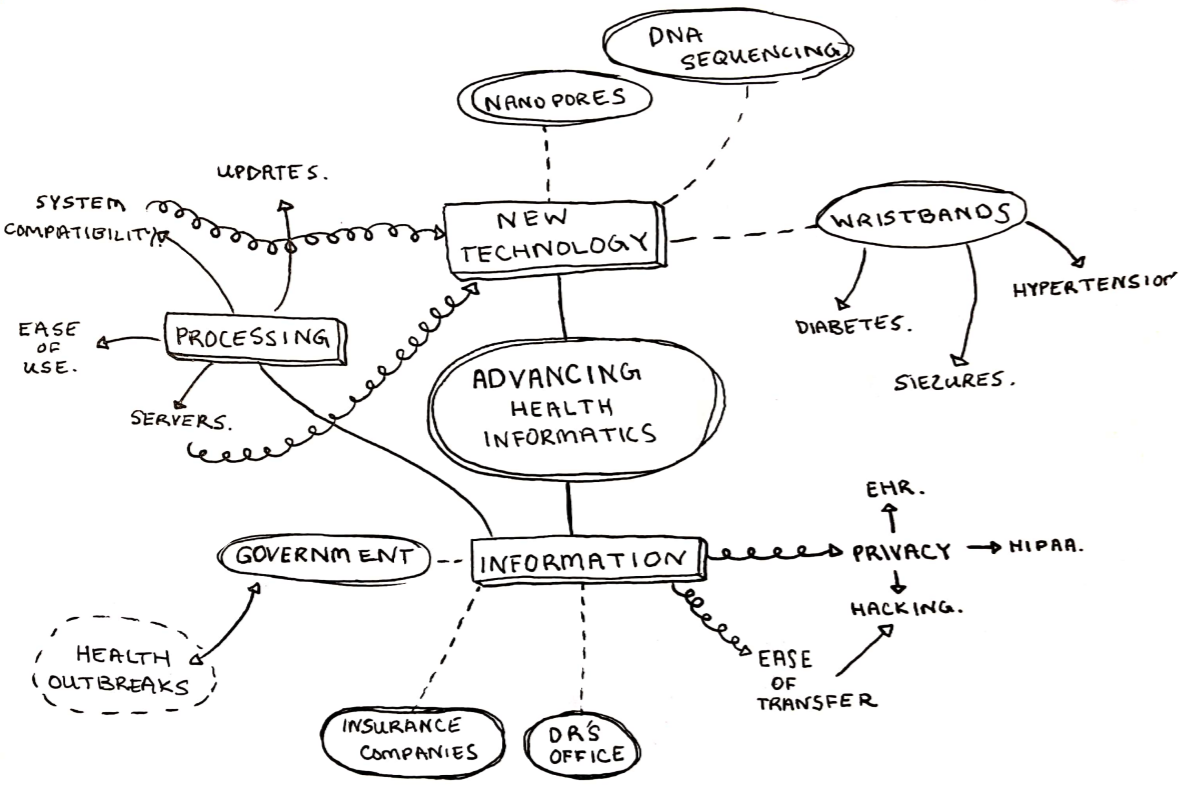
Our tether diagram has two major inputs: new technology and information. The new technology is vital for use and management while information is more for acquisition; however, both come with problems. We plan on explaining our diagram in depth during our presentation and also in our report. Our blog posts are short because we’ve made sure that we spend most of our time out of meetings doing work. We will be meeting Friday evening to practice our presentation.
As far as schedules go, we go off of the meeting. We do not have a specific schedule because there are days where we’ve been super ahead of schedule and days where we’re behind; a fleshed out schedule did not work great for us. Instead, a couple of days before each meeting, Sam creates a list of goals to finish before the meeting as well as during based on what has already been done and how busy we are with other things. I’m not sure if this is what you meant by project schedule but if not, feel free to let us know.
We apologize if our blog posts are underdeveloped but we just feel confident about the project and didn’t feel the need for a lot of questions. If you have any advice on how we can improve them so that they can be more valuable for both of us, we would appreciate it.
Also, we’ve included the outline of our essay that we created at our last meeting. It’s messy but I think you get the idea of what we’re planning on going for. To help focus each of us when we write a section on our own, we agreed on how to start each paragraph. We will come together this weekend to synthesize it better and get our first draft done.
Introduction
- Purpose
- Background Information
- Summary of information we included in the report
- What is an EGC?
- What is Sustainability?
- Thesis: Since health informatics acquires, manages, and uses critical information about patients worldwide, it is vital that it functions at peak efficiency. At this current time, the field suffers from several interwoven problems that makes this, undoubtedly, an engineering grand challenge.
Acquisition (First Supporting Paragraph)
Problems begin the root of health informatics: acquisition. Then bo goes off(on topic)
- New technology
- Conversion of Paper records(Paper to paperless)
Management (Second Supporting Paragraph)
The second hurdle comes with managing the acquired information. blasjf
- Privacy and security
- HIPAA
- Archives
- Ease of Transfer
- EHR
- Unifying health information system
- Why is this a wicked problem?
- Paradoxical nature
Use (Third Supporting Paragraph)
Due to previously stated issues, the data that has been acquired and managed has not been used in a manner that honors its full potential.
Fourth Paragraph
- Ethics
Conclusion

 Advance Health Informatics
Hi Team! Glad that you’re applying ethics to the project. I’m also glad that you started the tether diagram, but my hunch is that 2 iterations (first draft to final copy) is enough for the complexity of this project. We think of the tether diagram as more of a living document that grows out of your research and critical thinking. I’ll answer your question with a question: what do you think is most appropriate for the rhetorical situation of this assignment? You can comment back with your response if you like. Your blog post is a little underdeveloped compared to the other groups. Can you use the blog posts to show your Gantt chart / project schedule? A photo of the tether diagram you produced? The more you give us, the more timely feedback we can give you. Good luck! -SR
LikeLike
Hello Prof. Reynolds, we’ve added onto the blog post to hit on some of your concerns. If you could give us any more advice on how we can improve them, we’d appreciate it.
LikeLike
Hi team, thanks for this follow-up post. I wouldn’t recommend spending time buying clothes at Goodwill. Just wear whatever you have that is relatively nice and don’t worry about it. I would much rather have you spend that time working on the project than buying clothes, and I would never incorporate choice of clothing in a grade. Here is an IEEE citation style guide: http://www.ijssst.info/info/IEEE-Citation-StyleGuide.pdf. I’m really glad that you shared your tether diagram prior to the presentation, because I’d like for you to dig a little deeper and go into a bit more detail. In particular, health outbreaks are a pretty major part of NAE’s logic for this EGC – can that be fleshed out more in your diagram? Right now, for example, there is a measles outbreak in the Pacific Northwest. For your question about the project schedule, we expected teams to use a Gantt chart, similar to the one presented in recitation. This is one of the project management learning outcomes of the course. This will be absolutely critical in Module 5, and we had hoped that teams would build on Module 4 experiences in M5 (when the project will be more difficult and team size will increase). So, it’s a bit of missed opportunity here. The non-Honors students are required to do these and turn them in for a grade and you’ll need to know how to do them in upper-level classes. In Honors, we lean more and more on the students to take the initiative to apply knowledge, skillsets, and mindsets from the course. It’s great that you feel confident — but always take advantage of your resources. Oftentimes students are over-confident, and one reason we ask you to share through the blogs is so that we can help you along the way. If a team gets off-track and submits something that misses the mark, it’s a huge waste of time for everyone, and nobody learns anything. Your argument is responsive to the prompt in that it argues that HI is indeed an EGC, but develop the logic a bit further. For your paper outline, the content seems reasonable. It looks like you’re organizing the paper like a HS 3-paragraph (or 4, in your case) essay. This is not necessarily wrong, but it is also not the only way to write an academic paper. Reflect on the way that Hardin, Sandler, and Harvey argue compellingly in a very different organizational scheme. The idea here is that you are trying to persuade your audience to buy in to your argument, not just write a report. We spend a lot of time in college trying to break students of the HS 3-paragraph essay habit. Perhaps if you work together to flesh out the ethical analysis (which will prove to be immensely difficult), that will help you structure the paper to be as persuasive as possible. Thanks for providing the additional info and I hope this feedback helps you make good progress! Good luck!! -SR
LikeLike