The first and second groups we watched was discussing clean water. Right from the start, they clarified that their prompt was a wicked problem; however, the professors brought up that it is important to clarify if it is an EGC. The second group was more successful because they stated that right from the beginning. We believe that this is the most effective way to present an argument so that the audience does not wonder. The second group was further more effective because of their speaking skills. They were calm, collected, and took advantage of the rhetorical triangle whereas the first group kept reading off facts. Pathos became very important in driving their argument and increasing persuasiveness in the last moment of the presentation. They also reminded us of their argument throughout their presentation, making it an even more persuasive.
The group following us that also researched health informatics argued that the advancement of health informatics was not a worthy goal to be considered an EGC. There reasoning was that there should be more focus on medical technologies rather than health information. The group began by stating their argument clearly, but the remainder of the presentation faltered in its organization. There seemed to be some gray area regarding what counted as health informatics rather than medical devices and vice versa. They also wrapped the evidence of data breach into the EGC for cyber security. The final argument was that advancing health informatics should be partitioned into securing cyberspace, and engineering better medical technologies, and not considered its own EGC.
Before we came to watch presentations, we all agreed that our idea of how other parts of the world do or do not have access to fresh water was a bit narrow. The groups did a great job of expanding how we see problems that aren’t just ours and of showing the complexity that comes with an EGC.
Now, regarding our PowerPoint, we think we might have dropped the ball a bit with design. Our process of thinking was that the most important aspect of our presentation was the verbal communication; however, we could have done more to make our slides both visually appealing and communicative.
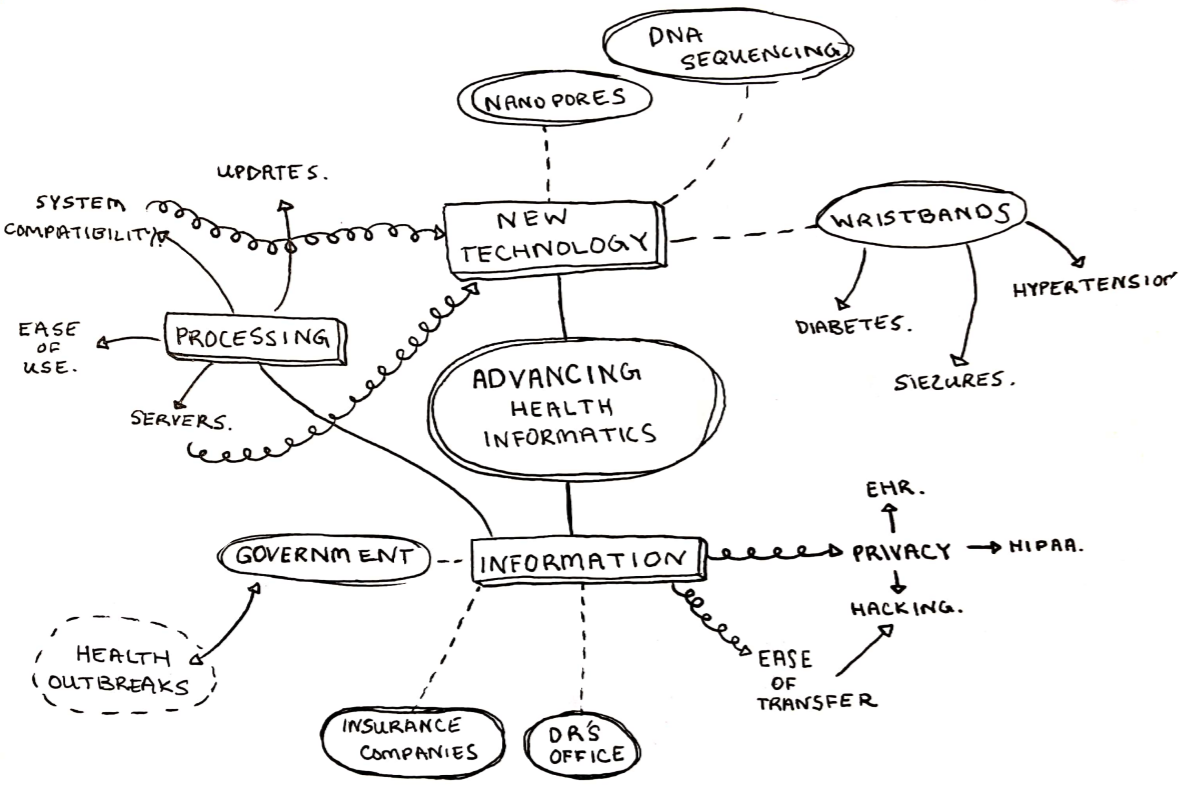
At our meeting, we began to discuss plans for our tether diagram, breaking health informatics into constituent parts and analyzing how each part depends on the other. We discussed inputs/outputs, major issues, opinions, and formatting. In discussion around new technologies in medicine, we stumbled upon some ethical questions. Where do advances in technology begin and humanity end? How do we separate the individual from the masses of information? Would you sacrifice privacy to benefit the greater good of social health? We hope to tackle some ethics in our project later on. We would like our tether diagram to represent our stream of consciousness on these topics.
By the end of the meeting, we drafted our first tether diagram. It has all of the information we would like, we just have to make a final copy. Question for Susan: Can it be drawn on paper and scanned into our presentation? Or would you prefer a digital copy? We also began thinking about how to begin our presentation. We would like to start with our ethical questions, then go into the powerpoint. Our powerpoint is almost finished, apart from our tether diagram. At our next meeting, we want to begin our paper and finish planning our presentation
Written by Julia (1.24.19)
BP o4
Today we met and made a plan for our remaining time before presentation date. We decided on practicing our presentation on Friday evening in the student center at 6:00. We also tentatively decided to shop for business casual outfits at Goodwill on Saturday. Our focus then shifted to our references. We created a bibliography in IEEE format but we are struggling. How should our references be cited in text?
Next, we began outlining our essay. With our completed outline, we decided to have each individual finish their paragraphs by Friday and then we will have a team write up of the introduction and conclusion. Our presentation will be based on our essay.
Written by Bo (1.29.19)
Our tether diagram has two major inputs: new technology and information. The new technology is vital for use and management while information is more for acquisition; however, both come with problems. We plan on explaining our diagram in depth during our presentation and also in our report. Our blog posts are short because we’ve made sure that we spend most of our time out of meetings doing work. We will be meeting Friday evening to practice our presentation.
As far as schedules go, we go off of the meeting. We do not have a specific schedule because there are days where we’ve been super ahead of schedule and days where we’re behind; a fleshed out schedule did not work great for us. Instead, a couple of days before each meeting, Sam creates a list of goals to finish before the meeting as well as during based on what has already been done and how busy we are with other things. I’m not sure if this is what you meant by project schedule but if not, feel free to let us know.
We apologize if our blog posts are underdeveloped but we just feel confident about the project and didn’t feel the need for a lot of questions. If you have any advice on how we can improve them so that they can be more valuable for both of us, we would appreciate it.
Also, we’ve included the outline of our essay that we created at our last meeting. It’s messy but I think you get the idea of what we’re planning on going for. To help focus each of us when we write a section on our own, we agreed on how to start each paragraph. We will come together this weekend to synthesize it better and get our first draft done.
Introduction
Purpose
Background Information
Summary of information we included in the report
What is an EGC?
What is Sustainability?
Thesis: Since health informatics acquires, manages, and uses critical information about patients worldwide, it is vital that it functions at peak efficiency. At this current time, the field suffers from several interwoven problems that makes this, undoubtedly, an engineering grand challenge.
Acquisition (First Supporting Paragraph)
Problems begin the root of health informatics: acquisition. Then bo goes off(on topic)
New technology
Conversion of Paper records(Paper to paperless)
Management (Second Supporting Paragraph)
The second hurdle comes with managing the acquired information. blasjf
Privacy and security
HIPAA
Archives
Ease of Transfer
EHR
Unifying health information system
Why is this a wicked problem?
Paradoxical nature
Use (Third Supporting Paragraph)
Due to previously stated issues, the data that has been acquired and managed has not been used in a manner that honors its full potential.
Today, we sat down and began to discuss our goals for our project, including defining what an EGC is, deciding whether our specific EGC fits those requirements, breaking down how sustainability works in regards to health informatics and underlining our next steps. We then synthesized our individual definition of an EGC that we gleaned from our research over the past week. We agreed an Engineering Grand Challenge is a call to action for engineers across the world. It is a challenge with both technical and cultural aspects which requires a solution that considers sustainability. To tackle these problems, a large amount of energy, effort, and people are needed and if these challenges are resolved, it will improve the quality of life for everyone around the world. Based on this definition we agree that advancing health informatics is an EGC as it is both culturally and technologically difficult to approach but will have many global benefits.
For the task of advancing health informatics, the issue of sustainability comes with the desire to provide and receive a constant stream of information. Furthermore, the technology itself must be consistent and up-to-date across different systems and offices. Whether we can maintain a system that works efficiently across the board is the biggest hurdle.
We also decided that, for the sake of clarity, we want to divide our research, presentation, and paper into the three subcategories of health informatics: acquisition, management, and use. We assigned management to Julia, use to Sam, and acquisition to Bo. Each member will write their portion of the essay and then the whole group will edit the paper as a whole for cohesiveness. By grouping our information into easier to understand segments, it will strengthen our argument, for having our audience completely in tune with what we argue will increase our persuasiveness. We also agreed that this is how we will present our powerpoint. Then, every member will have an equal speaking opportunity and be knowledgeable.
Meeting for tonight rescheduled to take place on Thursday 1/24 at 8:00pm in CoorsTek.
Each member will begin specifically researching their portion of the essay to share ideas at the next meeting. The following meeting will be next Tuesday 1/29 before IDEAS.
Today, we introduced ourselves to begin the meeting. In our group, there is Bo, Julia, and Sam. We all agreed that we want an A and are willing to put in the effort needed to get one. Quality work is important to all of us, but we would also like to learn something from this as well. We don’t need a get to know each other activity. At first glance, we aren’t really sure what we are doing. “Advance Health Informatics” is a very broad statement, so we decided to google what health informatics is. We found out that it is just the management of healthcare information. Right off the bat, we all think that this shouldn’t qualify as an EGC. We will, of course, research more and perhaps change our minds; this just doesn’t seem to be of the utmost importance. Also, wouldn’t this fall under the EGC “Secure Cyberspace?”
As a baseline, we will meet every Tuesday at 11 am right here in Coorstek. As we see fit, we will also schedule meetings at night in the library if needed. Digitally, we have a whole folder set up with a calendar, resources used, meeting notes, the rubric, and blog post requirements that we can all access at any time.
Next, we discussed our individual strengths. Bo mentioned that he is not a great writer, but is very good at collecting information. Julia is good at asking questions and interacting with TAs and professors. She is also a decent writer, works well under instructions, and loves constructive criticism. Sam is great at writing, organizing, and oral communication.
Week one will be for gathering information. We’ll take a look at the other EGCs and also collect as much information as we can regarding our own EGC. Week two will be for synthesizing our information, gathering our argument, and determining our own definition of an EGC. Week three will be putting our presentation together, practicing our oral communication skills, and beginning our paper. Week four is when we need to have our presentation ready. We all agree that we would like to have our paper finished when our presentation is finished. That way, we have a week to edit and refine our work.
As we said before, we will be meeting at 11 am on Tuesday 11/22 in Coorstek. We agreed that for week one, we will primarily do research on our own in a shared file. Week two, we will meet on Tuesday at 11 am and then 7 pm. That following Thursday, we will meet at 11 am.

 Advance Health Informatics